Managing mosquito populations in the upper Texas Gulf Coast requires addressing continuous humidity and expansive drainage networks. Houston maintains an average annual precipitation rate exceeding 49 inches, creating…
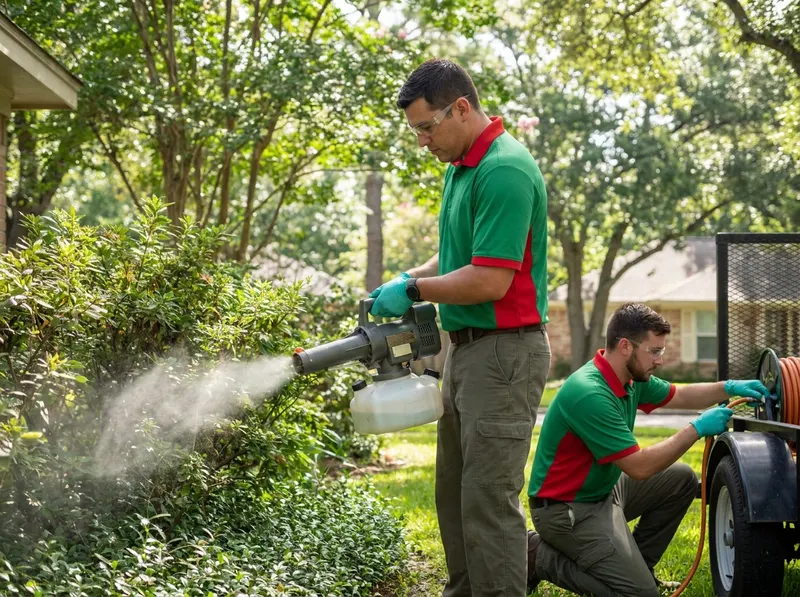
Managing mosquito populations in the upper Texas Gulf Coast requires addressing continuous humidity and expansive drainage networks. Houston maintains an average annual precipitation rate exceeding 49 inches, creating persistent standing reservoirs that enable rapid vector breeding. Under the supervision of structural control protocols governed by the Texas Department of Agriculture, professional barrier treatments disrupt adult rest zones while biocides suppress immature instars before emergence. Urban heat islands in dense pockets like Montrose, The Heights, and West University Place accelerate insect metabolism, compressing the egg-to-adult transition down to fewer than seven days during peak summer periods. Establishing a protective cordon requires targeted residual sprays to the undersides of broadleaf shrubs, shaded fence lines, and low-canopy trees up to a height of 10 feet where adult females rest during peak daytime heat.
A complete vector protocol combines physical containment with insect growth regulators rather than relying on broadcast misting systems that lose efficacy in open suburban wind patterns. Properties bordering riparian corridors near Harris County Flood Control District channels or extensive bayous encounter heavy immigration of floodwater mosquitoes. In mature, wooded tracts found across Spring Branch, Memorial, River Oaks, and Kingwood, dense leaf canopy shields breeding pools from natural evaporation. Specialized larvicides featuring biological agents like Bacillus thuringiensis israelensis neutralize larvae without disrupting surrounding non-target soil organisms. A recurring limitation occurs during heavy convective downpours, where flash rainfall can dilute surface applications on exposed lawns; treatments are therefore focused into protected microclimates beneath soffits, wood decking, and dense shrubbery.
Water management forms the structural boundary of mosquito exclusion. In suburban environments such as The Woodlands, Meyerland, and Clear Lake, properties frequently feature low-gradient landscape grading, corrugated French drains, and unsealed cisterns that retain stagnant water indefinitely. Technicians map these hydrological vectors, verifying drain cleanouts, elevated gutters, and dense groundcover to eliminate subterranean oviposition. TerraVance Bug Removal pairs biological larvicides with localized structural exclusion, preventing vector ingress through exterior crawlspace vents and patio thresholds. When property managers require confirmation on active mosquito species counts, public data from Harris County Public Health Mosquito Vector Control provides local density surveillance to guide site-specific mitigation.
Every job gets a firm, written price after a free on-site visit.
For standards, safe disposal, and service guidance on pest control services in Houston, TX, useful references include U.S. EPA, ENERGY STAR, U.S. Dept. of Energy, Consumer.gov, U.S. Census Bureau, and Google Maps. General consumer and small-business resources are available from USA.gov, Better Business Bureau, FTC Consumer Advice, U.S. Small Business Administration, and Ready.gov.
Tell us about your mosquito suppression program job in Houston and we'll send a clear, written quote, usually the same day.
 TerraVance Bug Removal