Subtropical ambient moisture across Harris County accelerates microbial decomposition inside enclosed roof assemblies. When rodent vectors penetrate building envelopes in established neighborhoods like Montrose, The…
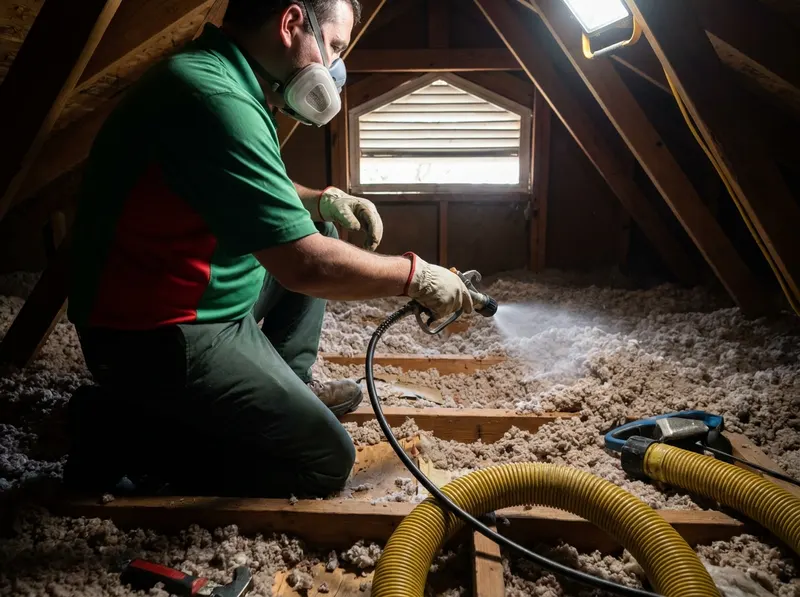
Subtropical ambient moisture across Harris County accelerates microbial decomposition inside enclosed roof assemblies. When rodent vectors penetrate building envelopes in established neighborhoods like Montrose, The Heights, or West University Place, they soil thermal barriers with urine markers and fecal pathogens. The Centers for Disease Control and Prevention guidance on rodent cleanup emphasizes that dry-sweeping droppings aerosolizes viral particles; structural preservation requires controlled HEPA negative-air filtration paired with broad-spectrum disinfectants. Leaving bio-soiled blown-in cellulose in place allows lingering pheromones to draw secondary invaders, including granary beetles and peri-domestic roaches, long after primary animal entry points are sealed.
Thermal performance declines significantly once organic debris compresses ceiling insulation. Blown loose-fill that has fallen below standard thermal resistance benchmarks outlined by the U.S. Department of Energy insulation guidelines forces cooling systems to run continuously under severe Gulf Coast heat loads. In areas like Spring Branch, Memorial, and Meyerland, older ranch foundations and traditional stick-frame roofs frequently share conditioned boundary voids with HVAC supply ducts. The EPA Indoor Air Quality standards document how negative duct pressure pulls ambient particulate from contaminated attics directly into ground-floor living areas, circulating biological contaminants through central air handlers.
The remediation process follows a systematic operational protocol: 1. Technicians seal ceiling penetrations and set a 1.5-horsepower commercial negative-air machine exhausting outside the home envelope. 2. Heavy biological deposits and compressed materials are removed using a high-cube vacuum hose feeding directly into external containment bags. 3. Bare ceiling joists, top plates, and rafter tails are misted with an antimicrobial surfactant registered under EPA FIFRA antimicrobial standards. 4. Critical envelope seams receive closed-cell foam barriers aligned with Energy Star attic air sealing criteria to halt vapor transfer. 5. Fresh borate-treated cellulose or fiberglass is positioned to restore code-compliant thermal depth. Property owners in heavily wooded areas such as Kingwood and The Woodlands face recurring tree-canopy animal pressures, making biological neutralization essential to halt repeat gnawing along structural roof lines. Work environments inside non-ventilated ceiling spaces regularly exceed 130°F during Houston summers, requiring technicians to follow heat illness directives defined by the OSHA occupational heat exposure regulations and respiratory filtration standards established under NIOSH respiratory protection criteria.
Mechanical integrity also relies on preventing microbial wood decay along attic framing. Unchecked rodent latrines elevate moisture contents within joists, creating conditions favorable for structural wood-destroying fungi described by the USDA Forest Service wood decay indices. Near coastal drainage zones such as Clear Lake, sustained relative humidity promotes pest-borne pathogen growth inside damp insulation. Specialized surface coatings conform to structural hygiene standards overseen by the Texas Department of State Health Services indoor air division to safeguard home residents, while structural clearance procedures reflect building envelope integrity parameters maintained by the HUD Office of Lead Hazard Control and Healthy Homes.
Every job gets a firm, written price after a free on-site visit.
For standards, safe disposal, and service guidance on pest control services in Houston, TX, useful references include U.S. EPA, ENERGY STAR, U.S. Dept. of Energy, Consumer.gov, U.S. Census Bureau, and Google Maps. General consumer and small-business resources are available from USA.gov, Better Business Bureau, FTC Consumer Advice, U.S. Small Business Administration, and Ready.gov.
Tell us about your attic insulation sanitization job in Houston and we'll send a clear, written quote, usually the same day.
 TerraVance Bug Removal